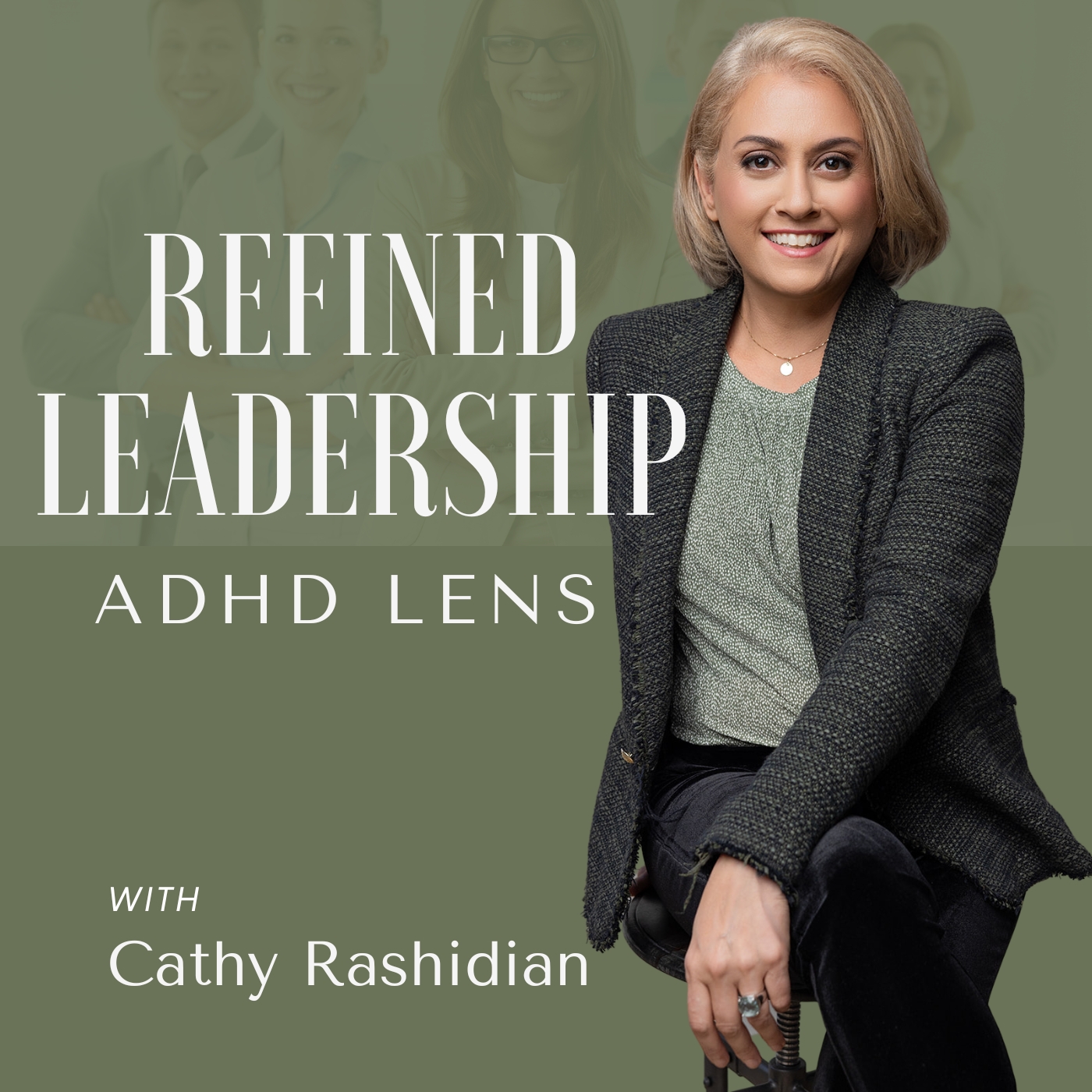
Refining Leadership for Professionals with ADHD

 Podchaser

 RadioPublic

 RSS Feed

 Apple Podcasts

 Spotify

 Overcast

 Castro

 iHeartRadio

 Deezer

 Amazon Music
In this episode of Refined Leadership ADHD Lens, Coach Cathy Rashidian explores the unique strengths that neurodivergent leaders bring to the table, including innovative thinking, hyperfocus, and resilience. Learn how these leaders drive innovation, build resilient teams, and make a lasting impact on organizations by harnessing their distinctive cognitive wiring.
Discover practical strategies for turning these strengths into sustainable leadership and creating psychologically safe environments for teams to thrive. Embrace self-awareness, intentional pauses, and authentic leadership to elevate your professional approach.
Checkout QTCommunity.com for group coaching for professionals with ADHD.
***********************************************************
Join our bi-weekly Group Coaching Quantum Thinkers' ADHD Community.
Join our Quantum Thinkers' ADHD Community for bi-weekly group coaching sessions. Tailored for professionals seeking guidance on managing ADHD in the workplace, Coach Cathy Rashidian offers valuable insights. Through her group coaching approach, she fosters growth and understanding among participants. Each session is limited to a maximum of 8 participants to ensure personalized attention.
***********************************************************
00:04 - Welcome to Refined Leadership
01:24 - Neurodiversity in Leadership
02:56 - Harnessing Hyperfocus
04:11 - Resilience and Tenacity
06:01 - The Dark Side of Strengths
08:08 - The Power of the Pause
10:00 - Building Sustainable Systems
11:34 - The Future of Leadership
12:49 - Join the Quantum Thinkers Community
0:00 Welcome to Refined Leadership ADHD Lens with Kathy Rashidian. Discover how to refine your leadership through the lens of ADHD. Whether you're advancing toward a promotion or redefining your professional approach, you're in the right place. Join our community for tailored insights that elevate your leadership. Let's dive in. Welcome to another episode with Coach Kathy. Today, we're going to unpack how neurodivergent leaders, those with unique cognitive wiring like ADHD, autism, dyslexia, and more are driving innovation, building resilient teams, and creating lasting impact.
0:40 Yes, people, some of us, we are doing big things, making big impact. And some of the clients that I work with, the community that I host. I see this on a day in and day out. The zest for moving projects forward, the strength in their ability to see big picture, thinking outside the box, all of that. It is so inspiring. So today I want to just kind of put it all in a bit of a package for you and kind of give you a bit of, this is what it looks like when even with cognitive differences, we can really have a voice and an impact in society, in the workplace.
1:24 So let's get started. So what's the big idea about neurodiversity and leadership, you ask? Well, imagine a leader who sees opportunities where others see roadblocks. Who dives into challenges with laser focus attention, actually, or who brings tenacity that keeps the teams steady when the going gets tough. That's the power that someone with a neurodivergent brain, especially a leader, brings to a table. Today, we're breaking this down into five takeaways that I'll show you how these unique strengths can transform organizations and how you can harness them, whether you're a neurodivergent yourself or leading a team of diverse minds.
2:13 With the first big idea being innovative thinking and strategic vision. So what does that mean? A neurodivergent leader often approaches problems from angles that others don't see. Their brains are wired to spot hidden opportunities, challenge the status quo, and calculate risks in a way that breaks the mold. Think of it like this. while everyone else is playing checkers, this type of leader is playing 3D chess. They're the ones saying, hey, what if we tried this totally wild idea and then it works? That's the kind of breakthrough thinking that drives real change in organizations.
2:56 Next up is hyperfocus and pursuit of mastery. When a neurodivergent leader locks onto something they're passionate about, it's like they've got a superpower. They'll dig into the details with an intensity that's almost unmatched, staying engaged with complex problems long after others have tapped out. It's not just about getting the job done, it's about doing it exceptionally and inspiring the teams to aim higher. Picture a leader who's so dialed in during a critical project that everyone else can't help but to catch up to that energy.
3:39 That is contagious energy, that zest for let's do this. It's pretty damn inspiring. And then there's the resilience and tenacity. These leaders don't just bounce back from setbacks. They push through them with a stubborn determination that's honestly. Again, inspires others. Whether it's adapting under pressure or keeping the team grounded, during uncertainty, their emotional strength becomes a rock for everyone around them. It's like having a captain who doesn't flinch when the storm hits. After all, if you know and have heard in the ADHD community, one of the things that those with ADHD are good at is in times of crisis, we can be awesome. them.
4:29 We're tuned in, tapped in, ready to go. So no wonder we go after jobs that are high stress, fast paced, and gets us, you know, our adrenaline going. Now, let me also be clear here. By no means am I glamorizing the hard work. And also the dark side of ADHD. And for those of us in leadership roles, the pressure that it can be. Each of these things that we just talked about, hyper-focus, resilience, innovative thinking, I personally think there's also a dark side to that.
5:09 If our innovative thinking is not received from the other side, it can really affect our confidence, our execution our focus our hyper focus the if we're in it for so long the exhaustion the burnout I call it the hyper focus hangover where there's days where you've been in hyper focus in a project for so long that on the other side of it is burnout you get really exhausted you haven't been yourself and also the resiliency that that I talk about as much as it can be a strength The other side of it is the toxic resiliency that I talk about, that we sometimes forget that sometimes fighting the good fight is not the right approach.
5:54 And there's times where we should really actually throw in the towel and move on and let go of things. So I want to make sure that I am seeing both sides of this, of the conversation as well. So how do you turn these strengths into sustainable leadership then? It's mastering your internal state, your emotions, just the way you're being. Neurodivergent leaders who thrive have figured out how to regulate their emotions. Manage overwhelm, and balance their energy. And this is not to perfection, but they're aware of it. We call it metacognition.
6:37 It's this sense of self-awareness. And I like to say self-awareness that is actionable, that you're just not aware that it's happening to you, but you're actually doing something about it. One trick that I like to talk about is the power of the pause. And for us with this fast brain or the brain that's constantly processing or slower processing, that divergent brain, let's say, is that the taking the simple step to pause for us doesn't come naturally. And so it's really being aware of it to say that when we take a pause, take a breath, wonders can happen. Amazing things happen.
7:19 So this example I have that I worked with a client was a leader who started taking a quick beat before answering tough questions in a meeting. And that quick beat was a couple of seconds or a one breath in, one breath out, one breath in, one breath out, and then this person would speak. That tiny pause let him check their emotional state, respond strategically, and set a calm tone for the team. It's simple, but it's a game changer. And it's really allowing your nervous system to also reset so you go from a fight or flight to actually tapping into the thinking part of your brain.
8:02 So do not underestimate the power of the pause and a breath that can do wonders. When it comes to practicality, building trust through authentic leadership is another method, and what do I mean by this? Confidence doesn't come from pretending you've got it all together. It comes from owning your strengths and advocating for what you need. And imagine modeling that with your team and with others and showing, you know what? I don't have it all together. There's times that I may not have all the answers, but together we'll figure it out.
8:42 Just being that open to conversation, to collaboration, creates that safety for the team so that they want to take risks and they want to collaborate. You're creating a space that's vulnerable, but also you're getting stuff done. And it's such a powerful technique. And it reminds me of that creating a space where everybody feels psychologically safe. And we use this term a lot in coaching. And by psychologically safe. What we mean in this context is creating dialogue and containers of conversation where everybody disarms. And it's not about upping one another. It's not about I have all the answers.
9:27 It's about disarming and acknowledging and validating the different minds and different contributions of the team. And then collectively coming up with solutions, ideas, and working with each other in a way that is supportive versus you don't listen to me, you like that finger pointing that could happen. So how do we put this all together? And for me, the way I look at this, it's about creating a sustainable system. Some of the other ways that you can incorporate this to become part of your ecosystem, if you will, is to really pay attention to what activates your brain, what drains your brain.
10:13 Do you need to create microbe breaks in between meetings? Really honoring your brain activation from processing from, wow, I was just really in an intense meeting and that took a lot of energy and I need five minutes to just be with myself and I and process what happened. It's about being mindful that single tasking or mindful tasking, it's better and more productive than multitasking. So if you're sitting in a meeting where you're in the listening mode and the temptation that comes from, let me check Slack, let me check my email. And instead, you know, be with a pen and paper and write down what you're hearing, what's inspiring you.
10:59 These are some of the ways that you can really intentionally pause throughout the day to make sure that you're honoring how your brain processes information. I think it's really important. Remember, you're in this for the long haul. And building systems and rhythms that make sense for you is so important. Here's the bottom line. The future of leadership is truly about self-awareness, but about actionable self-awareness. It's about knowing how your brain works. It's about reading the room to understand how does everybody else's brain work and how do we complement each other?
11:44 It's not about having all the answers, but it's about a collective of answers that come together and everybody has a piece of this pie. And organizations that embrace this perspective of every mind brings in a perspective that matters. You can adapt smarter, you can grow stronger, and you can really sit on the leading edge. And if you're a neurodivergent leader, start by recognizing your unique strengths first and foremost. Lean into them. Build in those intentional pauses that we talked about. Advocate for what you need unapologetically, but strategically and with compassion.
12:28 You've got the tools to create extraordinary value and the world needs what you bring. It's just about refining your leadership skills in a way that serves you first and foremost and then can influence and inspire others. So I hope you enjoyed this episode and picked up some clues and nuggets. And I also wanna give you my invitation that if you're ready to take the next level in refining your leadership skills, I have two exciting opportunities for you. One is that my application is open for private executive coaching, where we talk about integration of your ADHD into your leadership skills and so forth.
13:12 And the other, which is super, super exciting for me, is that our doors are now open to welcome new members to our quantum thinkers ADHD community. This is a community that we're building up, we're ramping up, we're accepting new members that are ready to take their career to the next level. We're being very specific on new members that are coming in. If you are in your career, five years plus, and you're looking to grow into different roles, leading roles, if you're currently a manager, a senior manager, a director, and leading teams, this spaces for you where we not only talk about leadership development, but also that missing key of how does the ADHD side of your brain work within those skills and how do we adapt and adjust your skills in a way that serve you and others.
14:09 And so my invitation to you is that Quantum Thinkers is now open for applications. We kick off the new members as of April 1st. We have our first group coaching session on April 4th. So if this is you, if this resonates, you want to know more about it, go to qtcommunity.com, qt, like Tom, community.com. And if you want to know more about my private coaching, readysetchoose.com and where you find all my services. So that's it for today. If this resonated with you, share it with a friend or drop us a review.
14:50 I would love to hear your thoughts on this episode. And until next time, keep leading with strengths and keep on shining. See you on the other side. Thanks for tuning in to Refined Leadership ADHD Lens. If today's episode resonated with you, do us a quick favor. Take just a few seconds to rate and review the show on your favorite podcast app. Your feedback not only helps the podcast grow, but it also makes this content reach more leaders like you. And if you know someone who needs to hear this, hit that share button and send it their way. Keep leading with strength and we'll catch you in the next episode.


